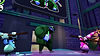
Project Role
Going Bonkers was developed as a student project at BUas. As level designer, I was responsible for the main level layout. My focus was on solid onboarding and creating fun co-op moment to moment gameplay.
-
Designed a drivable city
-
Designed & combined level ingredients to create interesting gameplay
-
Implemented dynamic camera framing
-
Designed special events
-
Worked closely with Tech-Artists for the blockouts
-
Balanced combat encounters
-
Made 3D asset blockouts during the concepting phase

Unreal

21 People

16 Weeks

Level Designer
Ideas & Sketches
Just Draw
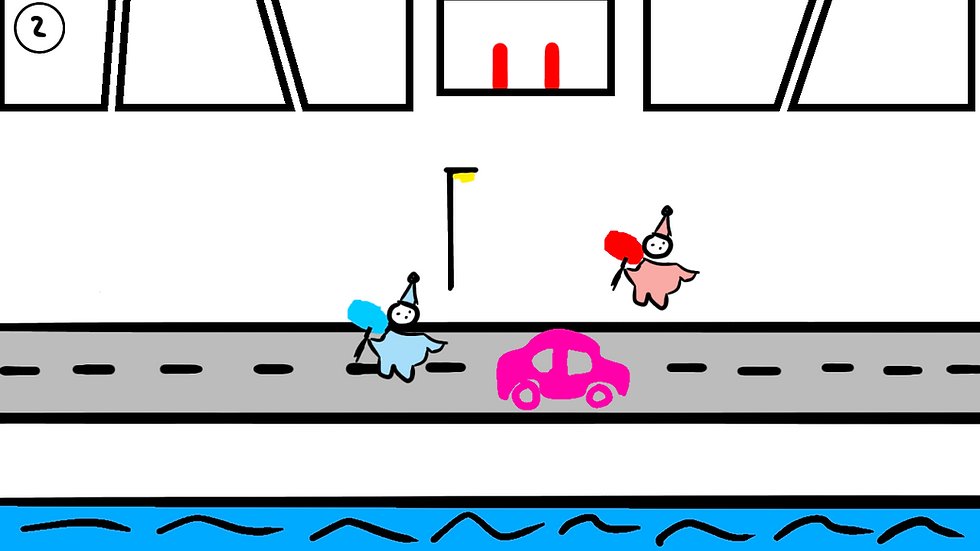
I use sketching as a quick way to brainstorm and explore ideas. By sketching, I can test layouts efficiently, allowing me to refine ideas and find what works best. Once a sketch is solid enough, I use it as a foundation for the first blockout.


Tutorial - Small Enemy (Scrapped)
A dedicated tutorial level was planned. Both doors would spawn a small enemy, one for each player to defeat.
Tutorial - Big Enemy (Scrapped)
The door would spawn a big enemy for both players to defeat.

Tutorial - Rolling Enemy (Scrapped)
The door would spawn a rolling enemy that would roll when hit. The players would have multiple ways to defeat it, either hit it in the water, or into the manhole (scrapped LD ingredient). The drawbridge was concepted here but was later replaced by the gate.

Wave 1
The first sketch of wave 1. Here, I focused more on the environment, adding lamp posts and benches. Crossroads with standard cars were also concepted.
Ending Wave (Reworked)
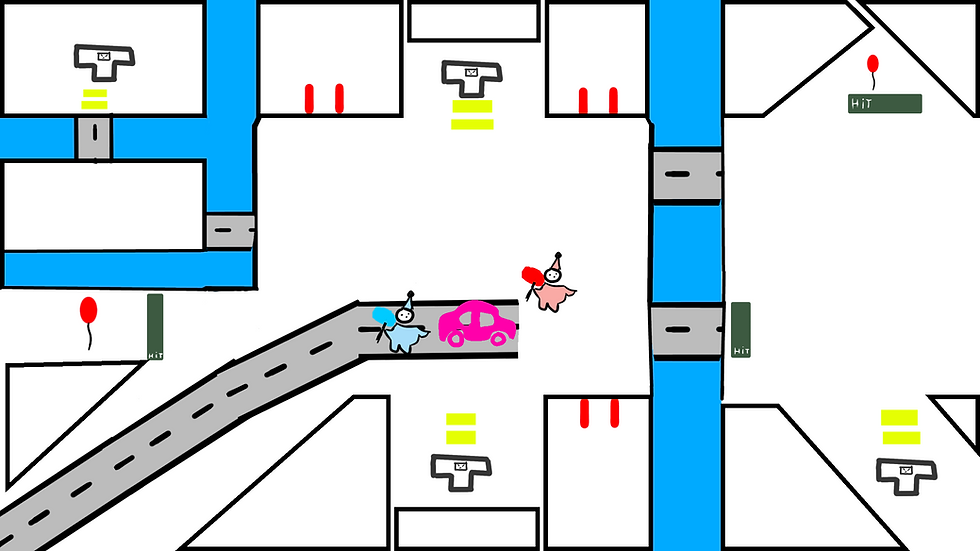
I helped design the final wave. The initial sketch suggested combining all level ingredients, but the area proved to be too large and difficult to balance. The skech did help start the development of the final wave.
Design Intent
Layout
The level was built in sections. Each section teaches new mechanics while increasing pressure on players. Camera framing and wave pacing were fine-tuned to balance readability with intensity.

I designed the onboarding to teach players mechanics in a safe and playful way. Early areas let players try out interactable cars without risk, helping them learn through experimentation. Cooperation is introduced right away by making players work together to progress, showing naturally how their actions affect the world and each other.
Onboarding

Events

The events were designed to bring together the mechanics players learned earlier in the level. The goal was to create fun, chaotic moments that naturally require communication and cooperation, pushing players to coordinate and use their abilities together to succeed. One player might figure out the problem quicker than the other, forcing them to communicate effectively.


Water is usually a type of hazard. Players can already experience this before reaching the blockade. Playtests revealed that players enjoy pushing objects into water. Here I combined both so players can safely figure out how to push the car into the water. The environment hints at this through the broken fence
Another blockade, but this time it involves a different car. Here, both players can safely figure out how to make the balloon cars float. The two cars on the side provide a visual hint and allow both players to experiment with the new mechanic. Only when both colored balloons are attached to the car will it float upwards.
The road is suddenly blocked. Players must apply their recently learned knowledge to cooperate and continue.
This roadblock is split in two obstacles. It combines all mechanic introduced into one big combat beat.


Development
Blockout Phase & Iterations
The blockout assets were created by me, following a city-themed layout. This approach allowed for quick iteration and testing of level flow and gameplay ideas. Because the shapes and spaces were simple, adjustments could be made rapidly, helping refine player movement and pacing early in development.
Through iterations, this area opened up, allowing for more space and enemy attack routes. Small turns were added to make the road less monotonous, and a short onboarding section was introduced.
Wave 1
Wave 2
Originally, this wave focused on the car ingredient and the new enemy, but playtests showed that players struggled to use the cars effectively.
The main iteration was the removal of the second beat, as it was too similar to the previous one and extended the level without adding meaningful value.
Iterations went back and forth, first using a road and then a bridge. Playtests proved the water was difficult to avoid.
The final iteration returns to a more streamlined design by placing the cars back on the road and adding a gate to better fit the theme.
Event 1 - 1
This area did not receive many iterations, aside from swapping the car and the balloon cart to the other side, which allowed the camera to achieve a better angle.
The building was removed due to awkward geometry and replaced with water, mirroring the design of the first area.
Event 1 - 2

Prototype based on sketches

First iteration changed the camera to a more isometric approach. The pushable car was added with another beat afterwards.

River was added to push the car into the water instead of between buildings. This was more fun for the player and easier for the camera.

Final version.

Prototype based on sketches

The turn was removed and replaced by a more open area to give the newly introduced enemy it's proper combat beat.

Final version.

Prototype based on sketches

The tunnel and the other cars were removed due to scope and replaced by another bridge.

Final version.

Prototype based on sketches

The car and balloon cart were placed on the opposite side for a better camera angle.

Final version.
Challenges
Framing
Keeping the game feel less monotonous by framing each combat encounter different proved tricky, as camera angles had to clearly show both players and enemies. The camera tended to clip into In the tall buildings quite often.

Balancing the enemy combat to fit the desired difficulty curve also required extensive tweaking and testing. There was a small line between the game being too easy and becomming mindless and too hard that we as level designers couldn't beat it. Iterating on small details took longer than expected since the level was an autoscroller, making each test cycle time-consuming, even with Unreal’s speed-up tools.
Balancing
I worked closely with the environment artists to make sure the set dressing supported gameplay. Since the game was already filled with bouncy and chaotic objects, we had to carefully balance visual clutter and playability. Regular communication and testing helped keep gameplay areas clear without losing the fun, busy look of the world.
Setdressing


Looking Back
Looking back, Going Bonkers was one of the most enjoyable and ambitious projects I have worked on yet. It helped me grow a lot as a level designer. I am proud of how the blockouts, gameplay beats, and encounters came together to create a fun and chaotic experience that still felt structured. Seeing players interact with the mechanics as intended was very rewarding.
Working closely with environment artists taught me how important clear communication is. Since the world was filled with bright and bouncy objects, I had to make sure gameplay areas stayed readable and easy to follow. This teamwork helped the final result feel both polished and fun to play.
If I could redo the project, I would improve the pacing and camera framing early on. Testing small changes was difficult because of the autoscrolling system, but it taught me a lot about planning and iteration. Overall, Going Bonkers became a great learning experience that showed how much I enjoy creating cooperative and playful levels.